Table Of Content
They are best kept to the very early stages of the design process when you need to quickly explore a variety of broader ideas or concepts. Prototyping is an extremely valuable step in the design thinking process. Putting the user at the heart of the process requires you to test your designs on real users—and prototypes make this possible without spending loads of time and money. It allows product teams to step outside of your usual problem-solving and decision-making patterns and consider diverse ideas and perspectives. It sets the base for innovation and potential product solutions that would otherwise remain hidden. Facilitate ideation sessions through a variety of activities and games.
Professional development
UVA Darden Professor Creates Guide to Design Thinking for the Greater Good With New Book, Online Course - The Darden Report
UVA Darden Professor Creates Guide to Design Thinking for the Greater Good With New Book, Online Course.
Posted: Wed, 02 Aug 2017 07:00:00 GMT [source]
The conceptual framework of key elements in designing a gamified online role-play. Participants suggested the gamified online role-play to have various levels of difficulty, so learners could have a chance to select a suitable level for their competence. The difficulties could be represented through patient conditions (e.g., systemic diseases or socioeconomic status), personal health literacy, and emotional tendencies.
User-centricity and empathy
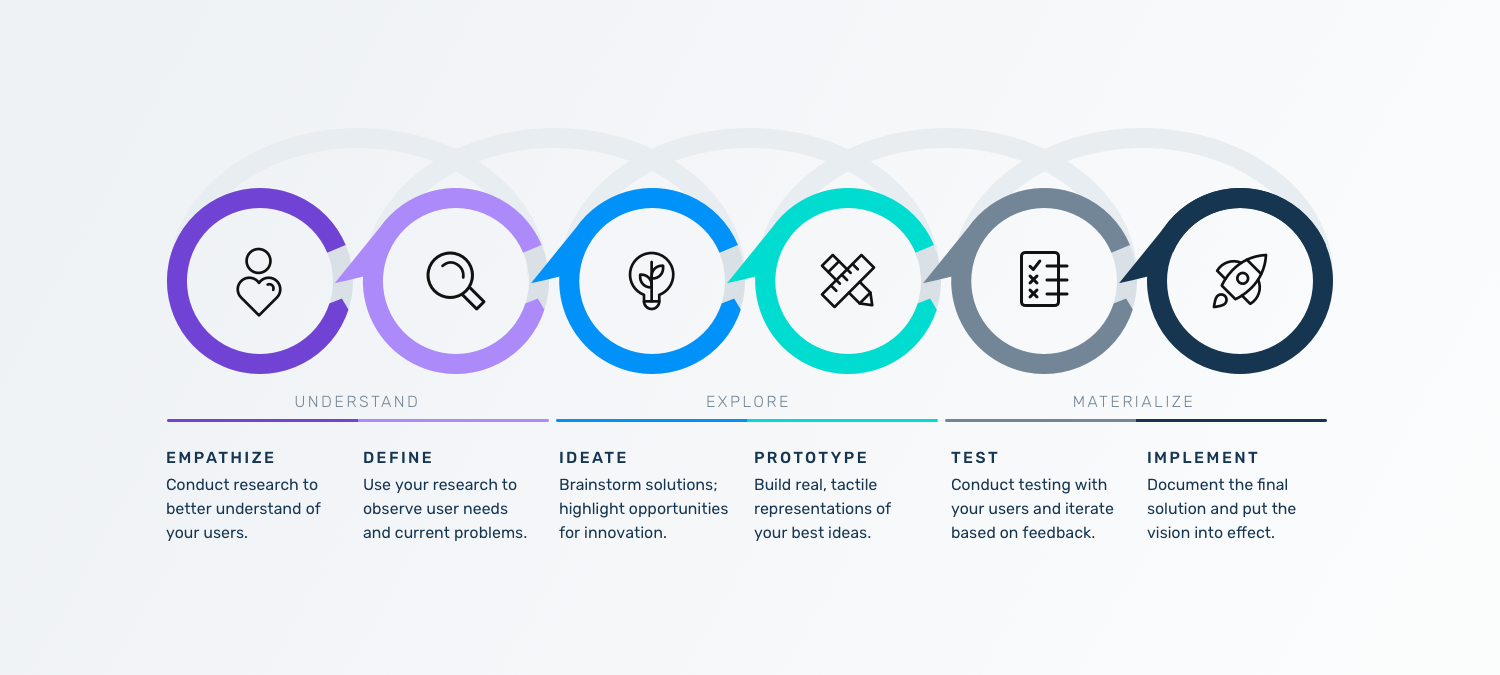
While frequently applied to product and service development, design thinking can be used in any field that requires creative thinking. Design thinking is an iterative process where teams seek to understand user needs, challenge assumptions, define complex problems to solve, and develop innovative solutions to prototype and test. The goal of design thinking is to come up with user-focused solutions tailored to the particular problem at hand.
Products
It can help you map out workflows and identify any decisions you need to make to bring your idea to life. Learn more about design thinking in the full-day course Generating Big Ideas with Design Thinking. Jakob Nielsen says “a wonderful interface solving the wrong problem will fail." Design thinking unfetters creative energies and focuses them on the right problem. This is the most important part of design thinking, but it is the one most often forgotten. As Don Norman preaches, “we need more design doing.” Design thinking does not free you from the actual design doing.
After that, participants connect their solutions and ideas by curves or lines to its minor or major (previous or following) fact or idea. There are literally hundreds of ideation techniques, for example brainstorming, sketching, SCAMPER, and prototyping. Some techniques are merely renamed or slightly adapted versions of more foundational techniques. Here you’ll get an overview of the best techniques as well as when and why to use them. Before releasing a product to market, you want to make sure that it works as intended.
As impactful as design thinking can be for an organization, it only leads to true innovation if the vision is executed. The success of design thinking lies in its ability to transform an aspect of the end user’s life. Brainstorm a range of crazy, creative ideas that address the unmet user needs identified in the define phase. Give yourself and your team total freedom; no idea is too farfetched and quantity supersedes quality.
The Ultimate Guide to UX User Stories [With Examples]

Use insights from Recordings, Heatmaps, Surveys, and Feedback to learn what your users need—and build a product that fits right in. And ideas you choose to learn from, tweak, and release to your user base can have a lasting impact on both your users and your company’s success and long-term viability. The final building block of the design thinking methodology is to consistently and cyclically take action. When user empathy is at the core of product development, everyone wins.
It combines investigations into ambiguous elements of the problem with rational and analytical research—the scientific side in other words. This magical concoction reveals previously unknown parameters and helps to uncover alternative strategies which lead to truly innovative solutions. Design thinking techniques and strategies belong at every level of a business. You should involve colleagues from a wide range of departments to create a cross-functional team that can utilize knowledge and experience from different specialisms. The core purpose of the process is to allow you to work in a dynamic way to develop and launch innovative ideas.
A randomized controlled trial with robust design should be required to compare the effectiveness of gamified online role-play with different approaches in training the use of teledentistry. Learning content appeared to be an important component of pedagogical aspect, as it would inform what participants should learn from the gamified online role-play. Based on the interview data, participants reported they could learn how to use a video teleconference platform for teledentistry.
CyberWorx "design thinking" delivers solutions to AF problems - Air Force Academy
CyberWorx "design thinking" delivers solutions to AF problems.
Posted: Tue, 19 Sep 2017 07:00:00 GMT [source]
The testing stage is normally one of the last stages of the design thinking process. After you’ve developed a concept or prototype, you need to test it in the real-world to understand its viability and usability. It’s where your product, design, or development teams evaluate the creative solutions they’ve come up with, to see how real users interact with them. The first stage of the design thinking process focuses on user-centric research.
Low-fi prototypes are also limited in terms of interactivity, so it’s not possible to convey animations or transitions. So how do you know whether to use a low, mid, or high-fidelity prototype? It all depends on what you want to achieve with your prototype, as well as how complete your design is. About 45 seconds into the video, a woman wearing a full-body gorilla costume walked across the screen.
Storyboarding is all about developing a visual story relating to the problem, design, or solution which you want to explain or explore. Storyboarding can help you bring a situation to life, it can show what happens over time, and explore the dynamics of a situation. You can use storyboarding after having empathised with people in order to better understand their lives.
NVivo (version 14, QSR International) was used to performed the qualitative data analysis. Subsequently, a conceptual framework was constructed to demonstrate emerging themes and subthemes together with their relationships. The quantitative data retrieved from self-perceived assessment and satisfaction questionnaire were analyzed with the Statistical Package for Social Sciences software (SPSS, version 29, IBM Corp.). Descriptive statistics were performed to present an overview of the data. One-way analysis of variance (ANOVA) was conducted to compare whether or not there were statistically significant differences in self-perceived assessment and satisfaction scores among the three academic years.
This also helps preventing people from becoming attached to their little works of art. As a rule, low-fidelity prototypes keep content and visuals to a minimum, presenting only the key elements as basic shapes in order to convey visual hierarchy. Their simplicity can lead to uncertainty during testing; it’s not always easy for users to identify what and how the prototype is supposed to work. Low-fidelity prototypes are ideal if you want to rapidly test broad concepts.
This may require going back to a prior phase to iterate and refine until you find a successful solution. Such an approach is recommended because design thinking is often a nonlinear, iterative process. While often used in product design, service design, and customer experience, you can use design thinking in virtually any situation, industry, or organization to create user-centric solutions to specific problems. We live in an era of experiences, be they services or products, and we’ve come to have high expectations for these experiences. They are becoming more complex in nature as information and technology continues to evolve. While design thinking is simply an approach to problem solving, it increases the probability of success and breakthrough innovation.


No comments:
Post a Comment